
Last updated: 2026-04-17
- Three inhabited islands, three characters: Koločep (car-free, sea caves), Lopud (sandy Šunj beach), Šipan (olive groves and konobas).
- The public ferry is cheap but realistically covers one island a day; a private boat does all three in eight hours.
- Best swim of the archipelago: Šunj bay on Lopud — real sand, waist-deep for 100 m.
- Our day cruise runs 09:00–17:00 from Gruž.
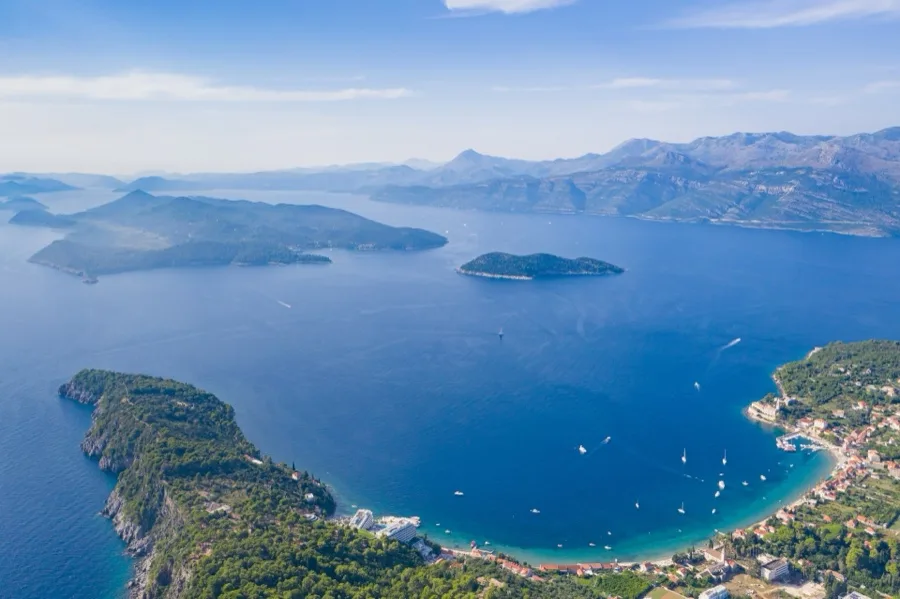
The Elaphiti Islands are a chain of thirteen islands and islets strung north-west of Dubrovnik, of which three are inhabited: Koločep, Lopud and Šipan. Together they hold fewer than a thousand permanent residents, almost no cars, and some of the clearest water on this stretch of the Adriatic.
I have skippered this route for twenty seasons, and it remains the day I recommend most often. The islands are close enough that you are never more than half an hour from the next harbour, yet each one feels distinct. Here is what actually deserves your time on each — and how to string them together.
What is there to do on Koločep?
Swim into the sea caves — that is the reason to stop here first. Koločep is the smallest and nearest of the three, about 25 minutes from Gruž, with two sleepy hamlets (Donje Čelo and Gornje Čelo) joined by a footpath through pines and agaves. There are no cars at all; the island’s south-western cliffs hide a series of grottoes, including a blue cave you can swim into when the sea is calm, where midday light turns the water electric.
By boat you anchor directly off the cliffs, which the ferry crowd never sees — the caves are unreachable on foot. Give it 60–90 minutes: cave swim, a snorkel along the rock face, coffee in Donje Čelo if you want your first shore stop early.
Why do people rave about Lopud?
Šunj beach — one of the very few genuinely sandy beaches in southern Croatia. The bay opens to the south-east, shelves so gently you can wade 100 m and still stand, and the water over sand glows a Caribbean shade of turquoise. For families it is the safest swim stop on the whole route.
Lopud town itself is worth an hour of anyone’s day: a palm-lined promenade around the harbour, the fortified Franciscan monastery founded in 1483 at its northern end, and the Ivan Kuljevan-era ship-owners’ villas that hint at how wealthy this island once was. Like Koločep it is car-free — golf buggies shuttle the sandy-footed between the harbour and Šunj if the 25-minute walk over the saddle does not appeal. The Dubrovnik tourist board lists the monastery’s opening hours by season.
Is Šipan worth visiting?
Yes — for lunch above all. Šipan is the largest Elaphite, a long fold of two limestone ridges with a fertile valley of olive groves, figs and vines running between its two harbours, Suđurađ and Šipanska Luka. Dubrovnik’s nobility built some 30 summer villas here in the Renaissance; a few survive among the olives.
This is the eating island. The konobas of Šipanska Luka grill the morning’s catch and pour local olive oil that never leaves the island in bottles. A long lunch here — octopus peka ordered when you arrive, an hour on the terrace watching the harbour — is the hinge of the whole day. Croatia’s national tourist board rightly files Šipan under gastronomy rather than beaches.
Ferry or private boat: which is better?
The ferry wins on price alone; a private charter wins on everything the day is actually for. The Jadrolinija ferry from Gruž is a fine way to visit one island cheaply. It cannot, however, take you into the caves, anchor off Šunj, or wait while you finish lunch.
| Public ferry | Private charter | |
|---|---|---|
| Cost | About €8–12 per person per hop | From €1,200 per boat, up to 12 guests |
| Islands in a day | Realistically one, two at a push | All three, unhurried |
| Timetable | Fixed; sparse outside summer | Yours — leave when you like |
| Swim stops | None underway | Caves, Šunj, any cove you fancy |
| Crowds | Shared deck, August queues | Your own boat and skipper |
With twelve guests aboard the Fairline Phantom 40, the day works out at €100 per person — details on the Elaphiti Islands day cruise page.
What does the perfect 8-hour route look like?
Caves while the light is high, sand for the middle of the day, Šipan for a late lunch — in that order. This is the timing I run when guests give me a free hand:
| Time | Stop | What you do |
|---|---|---|
| 09:00 | Depart Gruž Harbour | Coffee on deck, 25-minute cruise out |
| 09:30 | Koločep cliffs | Swim the caves, snorkel the rock face |
| 11:00 | Lopud harbour | Promenade, monastery, ice cream |
| 12:15 | Šunj bay | Anchor and swim off the sand |
| 14:00 | Šipanska Luka, Šipan | Long konoba lunch under the tamarisks |
| 16:15 | Cruise home | One last swim stop if the group votes for it |
| 17:00 | Back at Gruž | Salt-crusted and fed |
Every leg is 20–30 minutes, so nobody is ever “in transit” for long — and the order flexes. Honeymooners linger at Šunj; food-first groups go straight to Šipan and swim on the way back. In September I often reverse the loop entirely and finish with a late swim at the Koločep caves, when the low sun angles straight into the blue grotto.
Two practical notes: the caves need a calm sea, so a fresh jugo swell means we swap them for a sheltered cove on the lee shore; and Šipanska Luka’s best konobas fill by 13:30 in high season, so we phone your table ahead from the boat.
If you want the route exactly as written above, book the Elaphiti day cruise and tell us in the notes. If you would rather invent your own order, that is rather the point of having the boat to yourselves.